
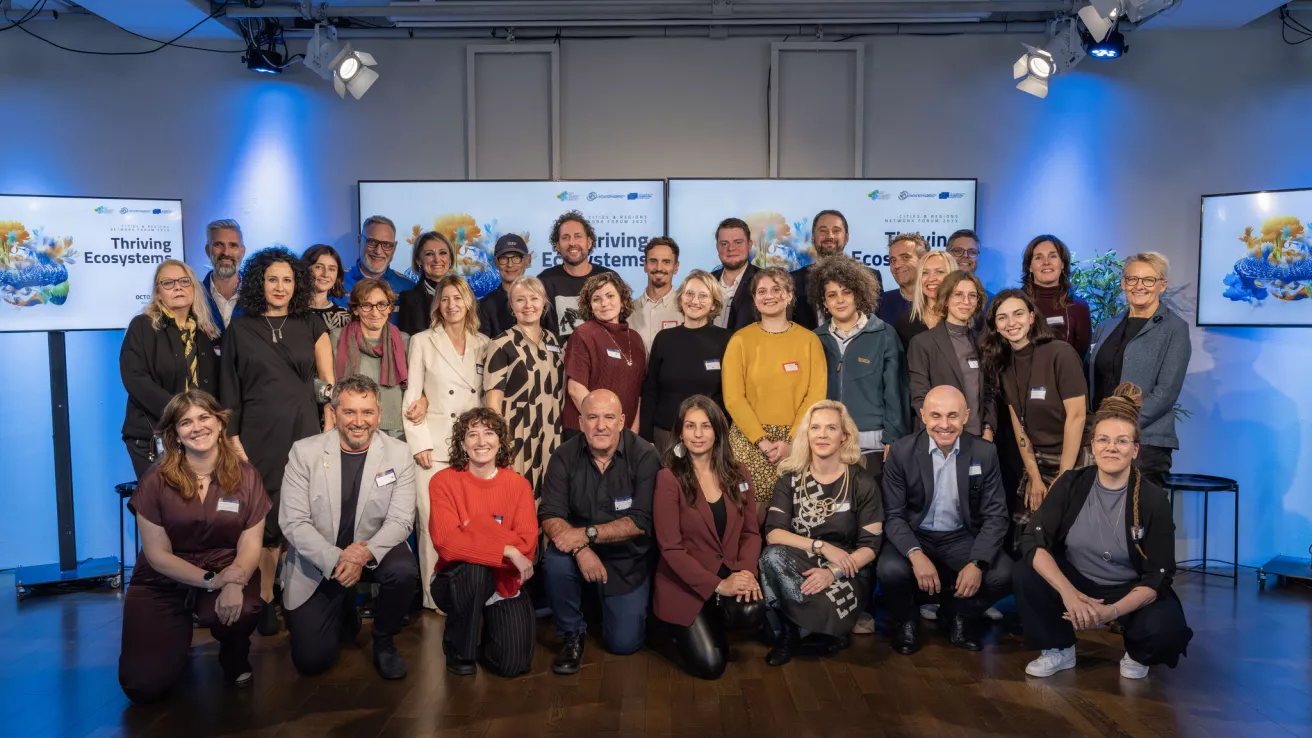
What happens when policymakers, artists, and city leaders and cultural representatives come together to rethink the future? The second in-person meeting of the Cities & Regions Network in Amsterdam offered a glimpse into the transformative possibilities of culture and creativity in local decision-making.
Launched in 2023, the Cities & Regions Network is a mission-driven community of EIT Culture & Creativity, focused on improving local decision-making through culture and creativity. It brings together over 50 delegates, including policymakers, representatives from local authorities and professional associations across Europe.
The second in-person gathering took place on 15 October at Pakhuis de Zwijger, coinciding with the World Cities Culture Forum, and featured inspiring keynotes and a hands-on workshop.
The day opened with collaborative artists Libia Castro and Ólafur Ólafsson, who presented their project Search for Magic: A Proposal for a New Constitution for the Republic of Iceland. As part of the long-running civic movement calling on the government to introduce a new constitution – already written and approved back in 2011–2012 following strong public demand – the duo invited composers, musicians, organisations, activists and citizens to co-create a multivocal music and visual art performance reciting all 114 articles of the proposed constitution.
“The arts are not only a field for expression but also for exploring complex questions through artistic thinking. This is how we developed our artistic practice as a collaborative team and began working with many others”, shared Libia.
The second keynote came from Erica Bol, Conscious Future Designer at the European Commission’s EU Policy Lab, exploring how speculative design, creativity and analytical insights can inspire new approaches to policymaking. She walked us through the Futures Gardens project, an experiential initiative using fictional artefacts from the future to encourage reflection and proactive policymaking. Alongside other initiatives, the EU Policy Lab is opening a dialogue: with policymakers, with citizens and with nature, to collectively envision and co-create desired futures.
“To support a sustainable transition, we need to change how we look at the world. That means thinking differently about policies – finding unexpected ways to listen and learn, imagining unusual ideas for designing them and exploring fresh approaches to decision-making. Ultimately, it helps us ask ourselves what kind of future we are aiming for”, she stated.

A space for exchange and collaboration
Delegates then took part in a hands-on workshop, engaging in a co-creation exercise to imagine future cities guided by the New European Bauhaus values of sustainability, beauty and inclusion – towards spaces where culture and creativity have a greater role.
Through a design-driven process developed exclusively for this session, participants worked through structured scenarios to tackle urgent societal challenges and aspirations. In a facilitated role-play exercise, they explored these scenarios from different stakeholder perspectives and prototyped policy actions using concrete tools – funding models, participatory approaches, cross-departmental strategies, creative mediation roles and small-scale pilots.
The outcomes of the session will help guide future priorities of the Network. Concepts that stood out include peer-learning residencies, experimental local policy labs and platforms facilitating access to context-specific knowledge on the CCSIs.

Becoming part of the network
Culture and creativity policies often operate in silos. While impactful on their own, they achieve far greater potential when connected to broader policy priorities. The Cities & Regions Network addresses this gap, ensuring that the sectors are meaningfully included in policies related to economic growth, innovation and regional and national development.
The Network provides a much-needed space for exchange aimed at developing integrated and collaborative policy actions. Future phases will continue to bring policymakers and local stakeholders together through intergroups and pilot projects focused on three shared priorities:
- Wellbeing and regeneration: Leveraging culture and creativity to nurture relationships between people and the planet through circular and intergenerational practices.
- Social fairness and cohesion: Strengthening inclusion, participation and community relationships through culture and creativity.
- Creative economies and fair work: Expanding our understanding of entrepreneurship and fostering skills and decent working conditions for thriving and competitive CCSIs.
EIT Culture & Creativity’s six Regional Hubs, covering 30 countries across Europe, will act as facilitators connecting actors across regions and scales for collaborative impact.
Interested in joining the Network? Have a look at the requirements and apply here.