
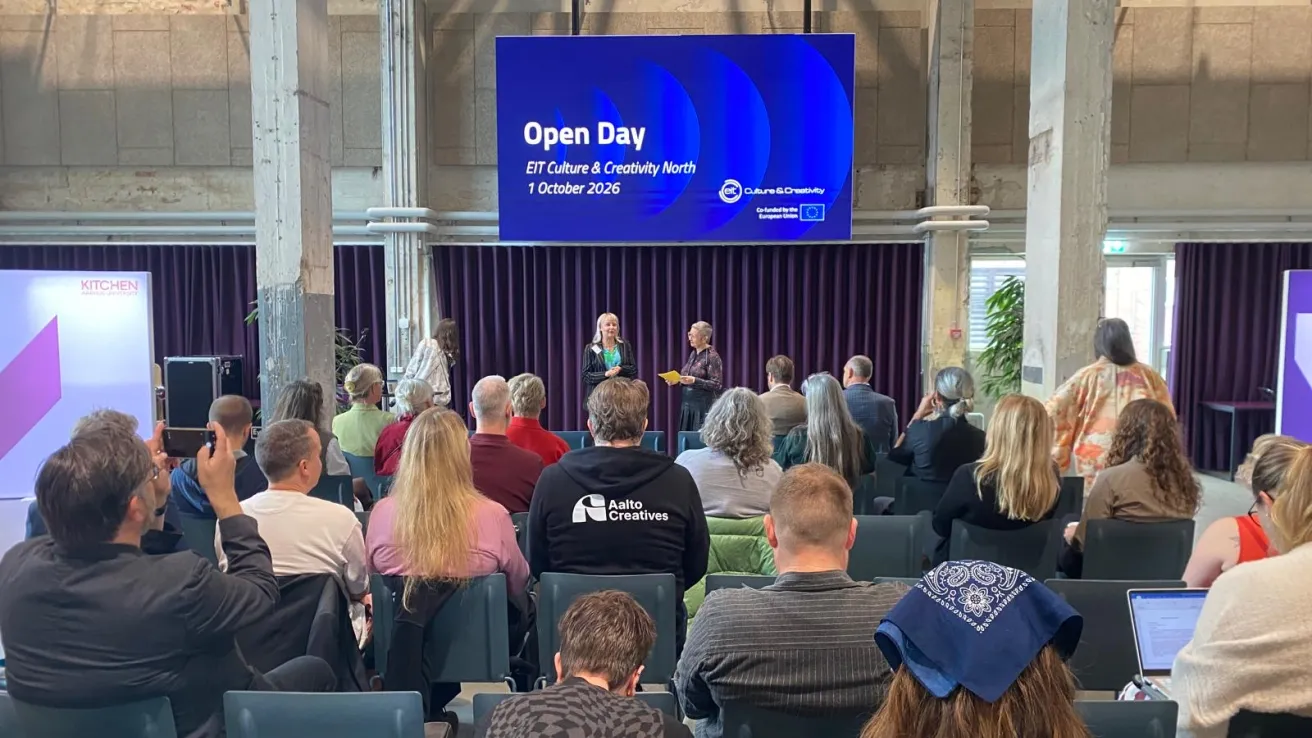
Ecosystems, improvisation and ideas: inside the EIT Culture & Creativity Regional Hub North Open Day in Aarhus.
How do you prepare Europe’s creative workforce for a world where skills require frequent renewal? That question was at the heart of the Open Day, held at Aarhus University on 1 and 2 October.
The North Regional Hub encompasses a diverse region of approximately 58 million people, supporting everything from gaming and design to architecture and audiovisual media. Open Days like this help to break down the silos that can exist between entrepreneurs, researchers, policymakers, students and creative practitioners – bringing everyone into the same room.
Day one: the case for new skills
The first day, moderated by Pernilla Glaser, a Swedish writer and facilitator, took place at Kitchen, a meeting place for innovation and entrepreneurship across Aarhus University, and was introduced by its Head of Innovation, Jeppe Dørup Olesen. It comprised talks, panels and pitches, along with news of upcoming EIT Culture & Creativity activities and calls.
Discussions around how to build skills capacity ran through the programme. Several speakers argued that building, renewing and updating skills is essential for versatile career paths today.
Niels Lehman, Vice Dean for Education at Aarhus University’s Faculty of Arts, drew on his background as a dramaturg to suggest that innovators have much to learn from theatre theory. Improvisation, he said, is about innovating and choosing our very near future. Rolf Hughes, EIT Culture & Creativity’s Director of Education, then presented the organisation’s new approach to understanding the role of education in the field and to supporting it.
Creativity can enable new ways of thinking about societal challenges. Alex Murray-Leslie, Professor of Digital Performance and a pop artist, presented MEATigation, a project exploring creative and artistic ways to transform Norwegian food practices towards eating less meat. One outcome was a pop song, which she performed for the audience as a delightful surprise.
The bigger picture for events like this is to strengthen the foundations for wider, systemic change in the North region and beyond. In a fireside chat, Ambra Trotto, EIT Culture & Creativity’s Director of Transformation, and Christina Melander, Chief Design Officer at Dansk Design Center, discussed the important role of ecosystems in sharing know-how and competencies at scale.
The session was followed by an event to mark the launch of the English edition of the handbook Cross Innovation in Practice, by Elin Frost, Jenny Kornmacher and Marlene Johansson. It is a guide to interdisciplinary collaboration that can open new opportunities for creative industries and culture in collaboration with other fields.
The afternoon focused on entrepreneurial careers, with partners such as Aalto and Aarhus universities providing substantial support for entrepreneurs in their respective countries and cities.
Day two: out into the city
Day two swapped the conference room for the city itself, to visit creative hubs. In the Aarhus K district, participants visited Godsbanen, a cultural production centre, and Institut for (X), a creative community where artists, entrepreneurs and other creative professionals can develop projects and set up workshops and studios.
In the Sydhavnen (South Harbour) district, they visited Filmby Aarhus, a hub for the audiovisual media industry, and Lifestyle Hub Aarhus, operated by Lifestyle & Design Cluster and serving as a meeting place for businesses in the lifestyle and design industries. Nearby, they explored Kulbroen, a public-space and cultural project that repurposes an industrial-era coal bridge, connecting Sydhavnen with central Aarhus.
A week of ideas
The Open Day capped a full week of events in and around Aarhus, a city renowned for design and urban innovation. “It is tremendous to see how the members of our network come together and bring their know-how to the joint table,” said Kati Uusi-Rauva, Director of the EIT Culture & Creativity Regional Hub North. “In our case, our Open Day was topped up with three other events, forming a full week of all things around CCSI development work, bringing some 200 people together during the days and showing the joint will of the community.”
On 28 and 29 September, Aarhus University and the CCSI Ecosystem, Region Central Denmark, hosted an ecosystem event in Ebeltoft, where participants discussed culture, creativity and art as drivers of societal resilience and creative repair across local communities and European regions.
On 30 September, partner organisation Time Machine Organisation hosted Time Machine Connect in Aarhus, exploring how cultural heritage data, digital technologies and creative expertise can combine to create new opportunities for innovation and collaboration.
That same day, Aarhus University brought together the leaders of EIT Culture & Creativity’s new Strategic Topic Groups to plan their future work. From October, these seven cross-European partnerships will tackle key challenges facing culture and creativity, turning collective knowledge into action.
Aarhus University’s Faculty of Arts and Time Machine Organisation are core partners of EIT Culture & Creativity, and we thank them for helping to make such a productive week possible.
On November 17, 2026, EIT Culture & Creativity North will bring people together again – this time in Helsinki for a creative brunch in KAAPELI, a side event at Slush 2026. Have a look!